As a regional centre committed to advancing mathematics education across Southeast Asia, SEAMEO QITEP in Mathematics (SEAQiM) has established a robust annual Monitoring and Evaluation (Monev) program. This initiative plays a crucial role in ensuring that the knowledge and skills imparted during SEAQiM’s courses translate into meaningful improvements in classroom teaching. The Monev program focuses on alumni of SEAQiM’s regular training programs in Indonesia, particularly those who have completed courses designed to enhance their teaching methods and content knowledge. The primary objective of Monev is to assess whether the training has led to a positive impact on teaching practices and, more importantly, whether it has contributed to creating a learning environment that is both meaningful and enjoyable for students.
The Monev process involves gathering data from alumni teachers who have not only completed their training but have also implemented and disseminated what they learned in their respective schools. The insights gained from these evaluations are essential for SEAQiM as they offer concrete feedback for improving the structure and content of future training programs. To ensure that the evaluation is comprehensive, the research team has developed several key performance indicators, which include the extent to which participants apply new knowledge and skills in their classrooms, the improvement in student learning outcomes, and the fostering of joyful and meaningful learning experiences.
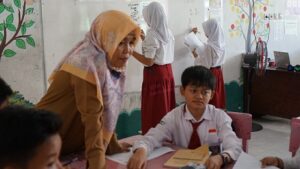
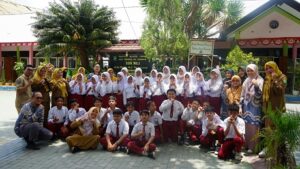
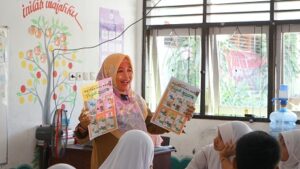
One of the first alumni to be observed in this year’s Monev was Ms. Fita Sukiyani, a dedicated teacher at SD N 1 Sumbawa, who previously participated in the “Teacher-Made Mathematics Teaching Aids” course. This course focuses on equipping teachers with the skills and creativity needed to develop effective, hands-on teaching aids for mathematics instruction. The Monev team in Sumbawa, consisting of SEAQiM observers Ummy Salmah and Miftahul Hidayah, conducted a detailed observation of Ms. Fita’s classroom during a two-hour mathematics lesson on 21 October 2024. The lesson, aimed at sixth-grade students, covered the challenging concepts of fractions and decimals, subjects that often require innovative approaches to make them accessible and engaging for young learners.
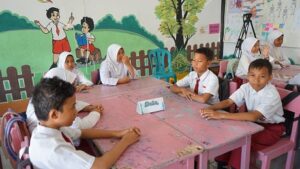
Throughout the observation, SEAQiM not only monitored Ms. Fita’s teaching methods but also documented the entire session through video recordings. This documentation serves multiple purposes: it provides a visual record of how the training is being applied in real classroom settings, and it will be used in future Monev reports and presentations to demonstrate the impact of SEAQiM’s programs at the elementary school level. The observation highlighted how Ms. Fita successfully integrated hands-on teaching aids into her lesson, which helped her students grasp complex mathematical concepts in a more interactive and enjoyable way.
In addition to observing the lesson, the Monev team conducted interviews with various stakeholders at the school to gain a holistic understanding of the impact Ms. Fita’s training has had. They spoke with students to gather their impressions of the class and how their understanding of mathematics has improved since Ms. Fita implemented the new teaching strategies. The feedback from students was overwhelmingly positive, with many noting that mathematics had become more engaging and easier to understand.
The team also interviewed the school principal, Ms. Nurhayati, who praised Ms. Fita’s contributions to the school. She emphasized that since Ms. Fita’s return from the SEAQiM course, there has been a noticeable improvement in student performance, particularly in mathematics. According to Ms. Nurhayati, Ms. Fita’s innovative teaching methods have not only benefited her own students but have also inspired other teachers at the school to adopt more creative approaches in their classrooms. This ripple effect underscores the broader impact of SEAQiM’s programs as trained teachers become agents of change within their school communities.
Ms. Nurhayati further explained that Ms. Fita’s ability to make learning both meaningful and enjoyable has had a transformative effect on the school’s academic environment. Students who previously struggled with mathematics are now more confident and motivated, thanks to the engaging, hands-on activities introduced by Ms. Fita. The positive feedback from both students and colleagues indicates that SEAQiM’s training not only equips teachers with new skills but also fosters a culture of joyful learning where students feel excited and empowered to tackle challenging subjects.
The results of this Monev will contribute to refining and enhancing future training programs, ensuring that SEAQiM continues to meet the evolving needs of mathematics teachers and their students throughout Southeast Asia.
photos: