YOGYAKARTA, November 6–14, 2026 — The STEM Villages program presented a series of learning activities centered on Science, Technology, Engineering, and Mathematics (STEM), featuring creative, interactive tasks and simple experiments for children. During the first two weeks of the program in November, four projects were carried out across several locations: the Joho Hamlet Office, the RT 7/RW 59 Community Hall in Sengkan, and the RW 58 Community Hall in Kolombo. These diverse activities were designed to encourage children to learn through hands-on experience: experimenting, observing, and developing their own ideas.
Through an experiential learning approach, children do not merely receive explanations of a concept; rather, they engage in a process of observing, experimenting, making predictions, testing outcomes, and refining their designs. Each activity was structured to be accessible to children of varying ages and abilities, while simultaneously fostering curiosity, creativity, collaboration, and problem-solving skills.
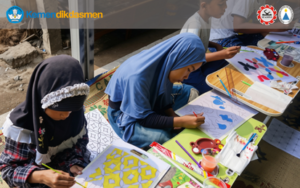
The series of activities began on November 6, 2026, with the Eco-Canvas Batik event held at the Joho Hamlet Office. During this session, children were introduced to batik, a piece of Indonesia’s cultural heritage, in a fun and child-friendly way. Using canvas tote bags, pencils, and acrylic paints, participants sketched simple batik motifs such as kawung, parang, or megamendung, and then decorated them with colors of their own choosing. Beyond fostering creativity and fine motor coordination, this activity introduced concepts like color mixing, repeating patterns, geometric shapes, and symmetry. The children also learned to develop their work in stages, progressing from the initial sketch to the final, detailed painting.
The next activity was the Fun Volcano experiment, held on November 7, 2026, at the RT 7/RW 59 Community Hall in Sengkan. The children decorated miniature volcano models and then observed a simulated eruption triggered by a reaction between baking soda and vinegar. This experiment provided an opportunity for the participants to make predictions, observe the formation of bubbles and foam, and compare the outcomes resulting from using different quantities of ingredients. Through this process, the children were introduced to basic scientific reactions, as well as concepts such as measurement, comparison, and recording observations in a table.
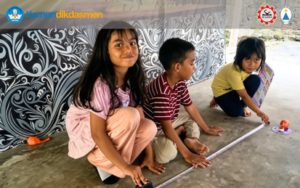
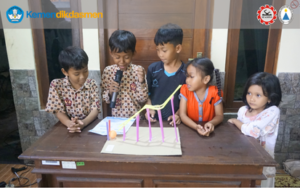
On November 13, 2026, the Kampung STEM program was held once again at the Joho Hamlet Office, featuring a Straw Roller Coaster activity. Using straws, ping-pong balls, adhesive tape, scissors, and cardboard as a base, the children designed and built simple tracks for the balls to travel from a starting point to an endpoint. They tested their tracks, observed the movement of the balls, and then refined parts that were not functioning as intended. This activity introduced concepts such as gravity, motion, potential energy, and the impact of track incline. Furthermore, the children practiced engineering skills—designing, building, testing, and refining their creations—while also applying mathematics by measuring the height and length of the tracks.
The fourth activity in the series, the Balloon Hovercraft, took place on November 14, 2026, at the RW 58 Community Hall in Kolombo. In this project, children assembled mini vehicles using repurposed CDs or DVDs and balloons. When air is released from a balloon through the center of a CD, a thin cushion of air forms underneath, reducing friction against a flat surface. The children observed how the hovercraft glided and experimented with simple variations, such as changing the size of the balloon or the type of surface used as a track. Through these trials, participants were introduced to concepts like air pressure, friction, and the conversion of energy into motion. They also had the opportunity to measure the distance traveled and the duration of the glide, comparing the results of each test.
These four activities demonstrated that STEM learning can be facilitated using simple materials familiar from everyday life. Each project provided space for children to ask questions, develop designs, explore various possibilities, observe outcomes, and make improvements. This approach not only helped participants grasp scientific and mathematical concepts, but also nurtured critical thinking, teamwork, and effective communication.
Through Kampung STEM, learning extends beyond the mere delivery of subject matter; it is brought to life through experiences that children can touch, observe, and engage with firsthand. By integrating art, experimentation, and engineering, the initiative aims to spark children’s interest in STEM while demonstrating that science, technology, engineering, and mathematics are present in the everyday world around them.
photos: