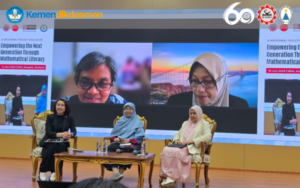
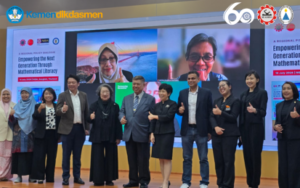
Bangkok, Thailand, 16 July 2026 – Education leaders, policymakers, researchers, and development partners from across Southeast Asia gathered at the Policy Dialogue: Empowering the Next Generation Through Mathematical Literacy, organized by SEAMEO STEM-ED at the National Institute of Development Administration (NIDA), Bangkok. The dialogue served as a strategic platform to discuss evidence-based approaches and regional collaboration in addressing mathematics learning challenges and improving mathematics literacy among students in Southeast Asia.
One of the key parallel sessions, “Unplugged Computational Thinking in Mathematics Education,” showcased the collaborative work of SEAMEO STEM-ED, SEAMEO RECSAM, SEAMOLEC, and SEAQiM in promoting computational thinking through mathematics learning. The session featured presentations by Dr. Orawan Sriboonruang (SEAMEO STEM-ED), Mrs. Cahya, Dr. Wan, Dr. Wara (SEAMEO RECSAM), and Dr. Sri Wulandari Danoebroto, Director of SEAQiM.
Representing SEAQiM, Dr. Sri Wulandari Danoebroto presented the Centre’s contributions to the regional initiative, highlighting classroom implementation, research findings, and scientific publications on Unplugged Computational Thinking (CT) in mathematics education. The presentation demonstrated how unplugged learning activities can effectively integrate computational thinking into mathematics lessons through hands-on, collaborative, and inquiry-based learning experiences.
The session highlighted SEAQiM’s classroom implementation in Indonesia, including demonstration lessons and classroom observations at Budi Mulia Pandeansari Primary School, Yogyakarta, and research conducted at 001 Sei Beduk Primary School, Batam. The findings showed that unplugged computational thinking activities encourage active student participation, strengthen mathematical reasoning, foster communication between teachers and students, and support the development of problem-solving and algorithmic thinking skills.
In addition to sharing implementation experiences, SEAQiM also presented its scientific publications documenting the impact of Unplugged CT in mathematics classrooms. These publications provide evidence of how computational thinking can be naturally embedded in mathematics learning, enabling students to recognize patterns, explore symmetry, organize procedures systematically, and communicate mathematical ideas effectively.
The collaborative session reflected the shared commitment of the participating SEAMEO Centres to advancing innovative mathematics education through research, classroom practice, and teacher professional development. The Unplugged Computational Thinking Guidebook serves as one of the region’s collaborative outputs to support educators in integrating computational thinking into mathematics learning without requiring digital technology.
SEAQiM’s participation in the Policy Dialogue reaffirmed the Centre’s commitment to contributing research-based innovations and regional collaboration in mathematics education, supporting the collective effort to improve mathematical literacy and prepare learners with essential computational thinking skills for the future.
photos: