
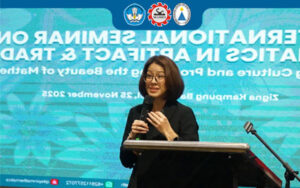
Surakarta, 25 November 2025 – Mathematics and cultural heritage may seem worlds apart, but SEAQiM joyfully demonstrated that the two are beautifully intertwined in the International Seminar on Mathematics in Artifact and Tradition: Appreciating Culture and Promoting the Beauty of Mathematics. Held onsite at the vibrant Zigna Kampung Batik Hotel in Surakarta and attended virtually by participants across Southeast Asia, the seminar also celebrated Indonesian National Teachers’ Day, marking the elegant fusion of culture, creativity, and mathematics in ways that surprised, delighted, and inspired.
The seminar is closely aligned with the Indonesian Ministry of Primary and Secondary Education’s policy emphasis on deep learning. SEAQiM supported the Cultural-Based Deep Learning as National Policy and embraces this direction by promoting pedagogical models that encourage meaningful understanding, creativity, and cultural appreciation in mathematics classrooms.
This lively international gathering, delivered in collaboration with SEAMEO SPAFA (Thailand) and SEAMEO CHAT (Myanmar), showcased SEAQiM’s endless commitment to enriching mathematics education through human experience, local wisdom, and cultural storytelling, all while preserving the region’s treasured heritage.
The joyful atmosphere, both onsite and online, is that mathematics can be warm, artistic, deeply human, and incredibly exciting, spotlighted by the prominent keynote speakers. The seminar invited participants to discover how Southeast Asian cultural expressions contain rich mathematical structures and aesthetic principles.
Asst. Prof. Dr Siramas Komonjinda, Chiang Mai University, Thailand, perfectly opened the first keynote session with an artistic voyage through archaeo-astronomy and world traditional art forms. Participants were captivated as she unveiled hidden geometries in everyday cultural expressions, patterns that reveal how mathematics quietly governs both structure and beauty. Her session blended the secrets of the world and mathematical logic in a way that made the audience see the objects with renewed wonder.
Next, Dr. Naw Si Blut from SEAMEO CHAT, Myanmar gracefully guided participants through Myanmar’s rich traditions, unveiling the numerical rhythms and spatial reasoning embedded in rituals, crafts, and architectural heritage. Her warm presentation about Interconnections between Mathematics, Artifacts, and Cultural Traditions in Myanmar transformed abstract concepts into lively narratives, making mathematical patterns feel familiar, personal, and deeply connected to identity.
Prof. Budi Nurani Ruchjana from Universitas Padjadjaran, Indonesia, closed the keynote with an enlightening exploration of ethnomodeling, showing how Ethnomathematics to Preserve Indonesian Culture carries mathematical principles that educators can meaningfully translate into learning. Her session was intellectually profound and reinforced the idea that culture-driven mathematics can strengthen students’ sense of belonging and curiosity.
Teachers, lecturers, pre-service teachers, researchers, policymakers, and educational stakeholders from across the region joined the event. Their participation highlighted a shared belief: meaningful mathematics education must connect to human experience, cultural roots, and local knowledge.
From joyful interactions to thought-provoking reflections, the seminar created a regional community bonded by curiosity and cultural appreciation—one that will continue to shape transformative learning in classrooms across Southeast Asia.
As one of the 26 regional centres under the Southeast Asian Ministers of Education Organization (SEAMEO), SEAQiM plays a crucial role in fostering cross-country cooperation in education, science, and culture. This seminar reinforces SEAQiM’s role as a regional leader in innovation, one that values both excellence and cultural richness. SEAQiM ensures that mathematics education becomes not only academically strong but also culturally meaningful, joyful, and deeply connected to the identities of Southeast Asian learners.