Yogyakarta, Indonesia – SEAMEO Regional Centre for QITEP in Mathematics (SEAQiM), in collaboration with SEAMEO CHAT, Myanmar, conducted the In-Country Course on Ethno-Realistic Mathematics Education for Numeracy Learning in Primary School from 7 to 9 October 2026. Held online through Zoom, the three-day programme focused on the use of ethnomathematics and cultural contexts to support numeracy learning in primary schools.
With the theme “Strengthening Numeracy through Ethnomathematics,” the programme introduced participants to the relationship between mathematics and culture. The sessions discussed how mathematical ideas can be found in activities and practices that are familiar to communities, and how these contexts can be used as part of mathematics learning.
The course features facilitators from SEAQiM, SEAMEO CHAT, and universities, bringing together expertise in mathematics education and cultural studies. The sessions cover a rich range of topics, including Current Issues in Preserving Culture, The Concept and Principles of Ethno-RME, Numeracy through Ethnomathematics, Myanmar’s Culture for Numeracy Learning, Ethnomath Workbook Analysis, and Developing Lesson Plans. Among the featured facilitators are Afit Istiandaru, who leads sessions on Ethno-RME, numeracy through ethnomathematics, Myanmar’s cultural potential, and workbook analysis, and Dr. Sri Wulandari Danoebroto, who facilitates the development of lesson plans integrating Myanmar culture into numeracy learning. Sessions on Myanmar’s culture are supported by SEAMEO CHAT/University of Yangon.
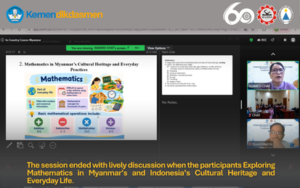
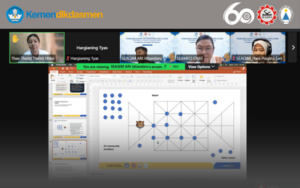
One of the sessions focused on mathematics in Myanmar’s cultural heritage. Participants were introduced to examples of mathematical knowledge found in traditional practices and cultural activities in Myanmar. The discussion showed how knowledge related to mathematics has developed within communities and has been passed from one generation to another.
The Myanmar Calendar was also presented as one of the cultural contexts for understanding mathematics. As a traditional lunisolar calendar, it combines the cycles of the Moon and the Sun and has been used in connection with religious, agricultural, and traditional activities. The example provided an opportunity to see how ideas related to cycles, patterns, and time can be connected to the cultural practices of a community.
Another session invited participants to look at historical buildings and cultural heritage from a mathematical point of view. Examples such as Tamansari Water Palace in Yogyakarta and Borobudur Temple were used to discuss shapes, patterns, structures, and other mathematical ideas that can be observed in historical sites. Such examples show that the environment and cultural heritage around students can also become learning resources for mathematics.
The programme also introduced the idea of Ethno-Realistic Mathematics Education, which connects mathematical learning with real situations and cultural experiences. Through this approach, teachers can consider contexts that are close to students’ lives when developing mathematics learning activities. This can help students relate mathematical concepts to things they already know and experience.
Beyond the learning sessions, the programme provided an opportunity for participants from Indonesia and Myanmar to exchange ideas about mathematics education. Different cultural backgrounds offered different examples of how mathematics is used and understood in daily life. These exchanges enriched the discussion and opened opportunities for participants to consider similar contexts within their own communities.
The three-day programme reflects SEAQiM’s continued effort to facilitate professional learning and regional collaboration in mathematics education. The experience with SEAMEO CHAT, Myanmar, also highlights the value of learning across cultures and sharing ideas that can be adapted to different educational contexts.
Through ethnomathematics, participants were reminded that learning mathematics can begin from things that are close to students—their surroundings, traditions, activities, and cultural heritage. The challenge for educators is to notice these mathematical ideas and bring them into the classroom in ways that are relevant to learners.
photos: