Probolinggo, East Java, 19 August 2026. What if the most powerful mathematics professional development does not begin with a presentation but with a classroom? What if teachers do not simply learn about teaching, but learn from teaching itself?
And what if a mathematics lesson could become a laboratory where teachers observe how children think, question why a particular strategy emerges, examine how a textbook guides mathematical reasoning, and then transform those observations into better teaching practices?
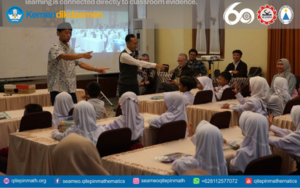
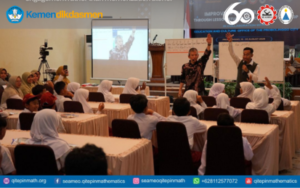
These questions came alive in Probolinggo, East Java, on 19 August 2026, as the SEAMEO Regional Centre for QITEP in Mathematics (SEAQiM), in collaboration with the Education and Culture Office of Probolinggo City, SEAMOLEC, and the Center for Research on International Cooperation in Educational Development (CRICED), University of Tsukuba, Japan, brought teachers together for an intensive “Improving Teachers Capacity Through Lesson Study and Robotics Workshop” at Balai Hinggil Kota Probolinggo, East Java.
Rather than positioning teachers as passive recipients of new knowledge, the activity placed them at the heart of the learning process, as observers, analysts, collaborators, and learners of learning itself.
The concept behind the programme recognizes that mathematics education in the 21st century can no longer be limited to memorizing formulas. Students need opportunities to develop higher-order thinking, creativity, numeracy literacy, logical reasoning, and the ability to learn mathematics through meaningful and engaging experiences. The programme therefore sought to strengthen teachers’ capacity not only to teach mathematics, but also to understand how mathematical thinking develops in children.
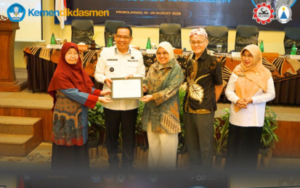
The day began with a powerful reflection remark from the Mayor of Probolinggo, Dr. H. Aminuddin, Sp.OG. (K), M.Kes. In opening the programme, the Mayor reflected on the development of education in Probolinggo and expressed his hope that the collaboration would generate tangible benefits for teachers and students. More ambitiously, he envisioned that if the approach proves successful, Probolinggo could become a model for other cities to learn from.
With 60 primary school teachers participating as lesson-study practitioners, six accompanying teachers, and 86 additional primary school teachers joining as observers, the activity created an unusually rich professional learning environment. Instead of one teacher teaching while others simply listen, dozens of educators could collectively examine what happens when mathematical ideas meet real children.
The classroom, therefore, was not merely a place where teaching happened. It became evidence. The programme explored three lesson-study themes designed to illuminate different stages and dimensions of mathematical thinking.
The first lesson focused on Grade 1: Composite and Decomposite of Numbers. At first glance, the topic may appear elementary. Yet this is precisely where foundational mathematical thinking begins: how young learners understand numbers, break them apart, reconstruct them, and gradually build relationships among quantities.
The second lesson moved into Grade 3 and Grade 4 fractions, exploring measuring fractions and quantity fractions. Fractions are notoriously challenging for many learners because they require students to move beyond whole-number thinking. Observing how students interpret fractions through measurement and quantity provides teachers with an opportunity to examine not merely whether students arrive at an answer, but how they construct meaning.
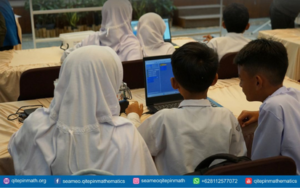
The third lesson brought the programme into a distinctly future-oriented space: Grade 6 robotic programming. Through robotics and programming, learners encountered a space where logical sequencing, problem-solving, precision, prediction, experimentation, and computational thinking could interact. The inclusion of robotics therefore represents more than the introduction of a technological tool. It opens a pathway for connecting mathematical reasoning with the competencies increasingly required in a technology-rich world.
The programme was strengthened by the presence of internationally recognized experts from the University of Tsukuba, Japan, including Prof. Masami Isoda, together with Mr. Tanaka, Mr. Nakata, and Mr. Tsuji.
Their contribution was not simply to demonstrate a Japanese teaching style. The deeper value lies in creating opportunities for Indonesian educators to examine the thinking behind the teaching.
The concept note specifically emphasizes the importance of understanding the flow of mathematical thinking presented through Japanese mathematics education references, including the Gakko Tosho textbook approach. Teachers are encouraged to understand how textbooks can support conceptual development and how lesson study can help translate those ideas into meaningful classroom practice.
The real measure of international cooperation in education is not how closely one country can reproduce another country’s classroom. It is whether an exchange of ideas enables teachers to see their own classrooms differently.
The activities identifies several intended outcomes, including strengthening teachers’ knowledge of primary mathematics teaching, understanding Japanese approaches to mathematics education, improving teachers’ ability to read and use mathematics textbooks, developing learning that strengthens critical reasoning and mathematical thinking, and improving teachers’ capacity to integrate ICT into mathematics learning.
photos: