
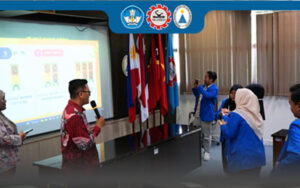
Yogyakarta, 6 January 2026 — SEAMEO Regional Centre for QITEP in Mathematics successfully conducted a Training on Unplugged Computational Thinking for Mathematics Education pre-service teachers from Universitas PGRI Banyuwangi. Held in the Conference Room, SEAQiM, Yogyakarta, the one-day training aimed to equip future mathematics teachers with essential computational thinking skills that can be creatively implemented in classroom learning.
The workshop was designed as an intensive 8-hour training program, combining conceptual understanding with hands-on activities. It focused on two main components: Introduction to Computational Thinking and Unplugged Computational Thinking Activities, each receiving equal emphasis to ensure balanced learning between theory and practice.
The event officially opened in the morning by Dr Sri Wulandari Danoebroto, the director of SEAQiM, setting the tone for a collaborative and forward-looking learning environment. Dr Wulan also opened the future collaboration and partnership between SEAQiM and Universitas PGRI Banyuwangi.
In the first sessions, participants were introduced to the core concepts of computational thinking, including problem decomposition, pattern recognition, abstraction, and algorithmic thinking. These sessions were facilitated by Ms Wisnuningtyas Wirani, who guided participants through interactive discussions and contextual examples relevant to mathematics education.
Following the conceptual sessions, the workshop continued in the afternoon with Unplugged CT Activities, facilitated by Mr Rizky from Universitas AMIKOM Yogyakarta. In this segment, participants actively engaged in a series of collaborative and problem-solving activities designed to demonstrate how computational thinking can be taught using everyday materials and interactive methods. These activities highlighted that meaningful computational thinking instruction does not always require computers, making it highly applicable for diverse classroom contexts.
Throughout the training, participants showed strong enthusiasm and active involvement. By strengthening computational thinking skills among pre-service teachers, the program helps prepare a new generation of educators who are adaptable, creative, and ready to face evolving educational challenges.